GoDaddy vs Estibot vs Atom: Appraisals Compared on Real Domains
These are the three appraisals people quote most: GoDaddy because it is free and everywhere, Estibot because it is the veteran, Atom.com because it speaks for the brandable market. Run the same names through all three and they rarely land in the same neighborhood, a pattern Domain Name Wire's May 2026 review of appraisal tools documented across the board. The disagreement is not noise. Each model was built on different data to answer a different question, and once you know each one's lean, the numbers become useful again.
How does each model actually work?
GoDaddy Appraisal: machine learning on yesterday's market
GoDaddy trains on historical aftermarket transactions, including its own huge auction flow. That gives it the deepest wholesale dataset of the three, and a matching weakness: it reflects what similar names fetched in past years, not what a trend is doing right now. Fast-moving segments are where lag shows up most; a model anchored to history is structurally late to a market where .ai names took a reported 29% of 2025's top 100 public sales. It also has a habit of producing plausible mid-range values for names no human would buy, because something in the string matched something that once sold.
Estibot: keyword math from the search era
Estibot is the oldest of the three and thinks in keyword metrics: search volume, advertiser cost per click, extension statistics. Names built from commercially searched words score well; coined names score near registration fee because a made-up word has no search volume by definition. That made sense when exact-match domains carried ranking weight. In 2026 it makes Estibot a decent proxy for keyword demand and a poor judge of the brandable names startups actually pay for.
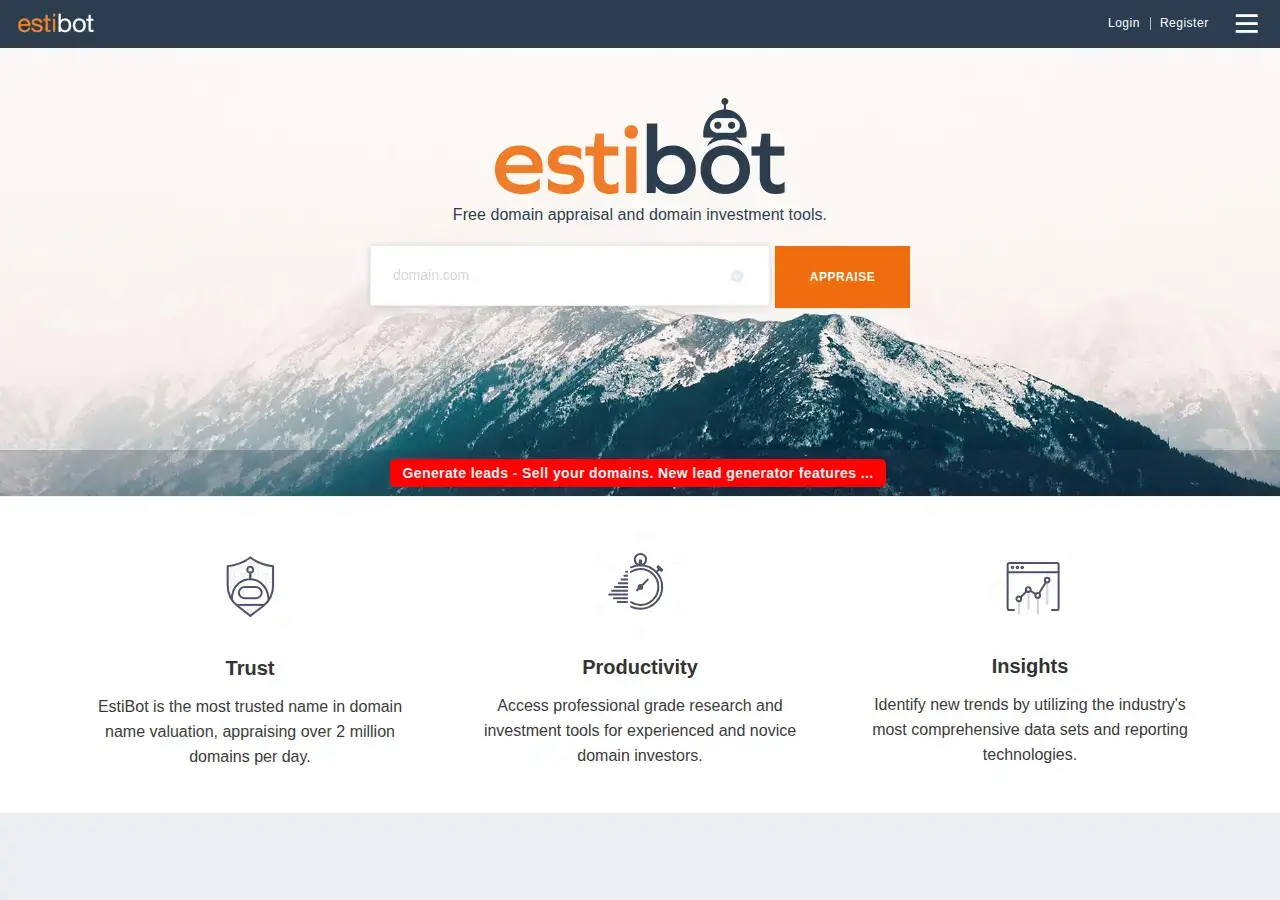
The Estibot homepage and appraisal search box, captured August 2026
Atom.com: the brandable marketplace's own lens
Atom, the marketplace formerly known as Squadhelp, ships an AI appraisal shaped by the curated brandable inventory it sells, and since February 2026 pairs it with a research product called Domain Hunter. Its lean is the mirror image of Estibot's: invented, pronounceable names get healthy retail-flavored numbers because that is Atom's home turf, while flat generic phrases impress it less. Read Atom as the optimistic retail ceiling for brand-style names, not as a prediction of what an auction will pay you next week.
What does the spread look like on real domains?
Rather than invent a fake benchmark, here is the shape you can verify yourself in an afternoon, and the one the May 2026 tool review found on identical names: the three models diverge along exactly the biases above.
| Name profile | GoDaddy tends to | Estibot tends to | Atom tends to |
|---|---|---|---|
| Two-word keyword .com (e.g. a service phrase) | Land mid-pack, guided by old auction comps | Score highest of the three when search volume exists | Sit middle, unimpressed by plain phrases |
| Coined brandable (invented, pronounceable) | Produce a modest, history-driven figure | Fall lowest, often near registration fee | Score highest, reflecting brandable retail asks |
| One-word dictionary .com | Go high, yet still below what end users pay | Go high if the word is searched commercially | Go high on brand appeal |
| Short liquid name (four-letter .com) | Track past auction ranges reasonably | Undervalue unless letters spell a keyword | Vary with pronounceability |
| Trend TLD name (.ai and friends) | Trail the trend it has not trained on yet | Give mixed, keyword-dependent results | Read stronger, closer to startup demand |
An illustrative example with made-up numbers, to show the shape rather than any live result: a coined name in the style of "Voxlio.com" might return several hundred dollars from GoDaddy, under a hundred from Estibot, and a few thousand from Atom. Same asset, three answers, an order of magnitude between the extremes. The specific values do not matter; the consistency of the pattern does.
Why do they diverge this much?
Because each predicts a different market with different blind spots. GoDaddy models wholesale history, Estibot models search-era keyword demand, Atom models brandable retail asks. None of them models liquidity, trademark risk or the single most important variable, whether an end user for this exact name exists. A model can only compress the data it was fed, and the three were fed different markets. Public sales data is also thin: NameBio recorded roughly 190,300 sales in 2025, an estimated 5-10% of retail activity, so every model extrapolates from a sliver. We walked through the fix, comps plus judgment, in our guide to appraising a domain in 2026.
Which appraisal should you use for what?
- Quick free sanity check: GoDaddy. It is instant and roughly calibrated to wholesale history, which suits reseller math.
- Keyword demand screening: Estibot. Treat its number as a demand signal for the words, not a price for the name.
- Brandable ceiling: Atom. Useful for setting an ambitious retail ask on coined names, the way startup buyers would encounter them on a marketplace.
- Actual pricing: none of the three. Pull comparable sales from NameBio and quote wholesale and retail separately.
- Expired-name research: a different job entirely. Appraisers guess what a name is worth; a research tool like DomCop shows which names are dropping with age, backlinks and clean history worth appraising.
The honest verdict: use all three the way a surveyor uses three landmarks, to triangulate. When GoDaddy, Estibot and Atom agree, you have a boring name whose value is well understood. When they disagree wildly, you have learned which market each model thinks your name belongs to, and that is genuinely useful information that no single number provides.
Frequently asked questions
Is the GoDaddy domain appraisal accurate?
It is consistent with historical aftermarket patterns, which makes it a reasonable wholesale sanity check. It is not a prediction of what an end user will pay, and independent comparisons such as Domain Name Wire's May 2026 review found it disagreeing sharply with other tools on identical names.
Why does Estibot value my brandable near zero?
Because Estibot's model runs on keyword metrics, and an invented word has no search volume or cost-per-click data. That is a limitation of the model, not a verdict on the name; brandable marketplaces sell coined names for four and five figures regularly.
Is the Atom appraisal inflated?
It leans toward retail asking prices in the brandable market Atom itself operates, so it usually reads higher than wholesale reality. Treat it as an optimistic ceiling for the right buyer, and expect auctions to pay a fraction of it.
Should I show appraisal screenshots to buyers?
Only when the number helps you. An end user anchored by a free GoDaddy estimate above your ask closes faster; an investor will ignore the screenshot and quote comps back at you. Never let any model argue you below what comparable sales support.
Do these tools account for backlinks and SEO history?
No. All three appraise the name string, not the asset attached to it. An expired domain with a decade of age and a clean link profile carries value none of these models can see, which is why expired-name buyers evaluate history with research tools and treat string appraisals as a separate exercise.